You are forty thousand words into your novel. Your protagonist has been established as cold, guarded, someone who never explains herself. Then you open Chapter 11 and find a scene — one you wrote at midnight three weeks ago — where she opens up to a stranger on a train, telling him about her childhood in the kind of detail she would never share with anyone.
You don't remember writing it. You can't tell if it's a continuity error or a character breakthrough. You spend forty minutes re-reading earlier chapters trying to work out which version of her is the real one.
This is the story bible problem. Not the dramatic kind — eyes changing colour between chapters, cities moving between chapters — but the quieter, more corrosive kind. The accumulated weight of small uncertainties that slow you down and make you distrust your own manuscript.
A story bible fixes it. Here is how to build one that actually works.
What a Story Bible Is (and What It Isn't)
A story bible is a reference document that captures everything that is true about your story world. Not what happens — that is your outline. What is. The facts that do not change regardless of which scene you are writing.
Your protagonist's eye colour. The floor plan of the house where the third act takes place. The rule that magic in your world costs the user something physical. The way your antagonist speaks — always formally, never contracting words, a habit from a boarding school childhood.
Screenwriters have used story bibles for decades. Every long-running television series has one: a document the writers' room uses to ensure a character in episode 40 behaves consistently with who they were in episode 2. Novelists rarely bother, because a novel usually has one author who, theoretically, holds the whole story in their head.
In practice, nobody holds a 90,000-word novel in their head. Certainly not across the months — sometimes years — it takes to write one.
The story bible externalises your story's memory. It is the single document you consult before you write any scene that involves a character, a place, or a rule of your world. Keep it updated and it will save you more revision time than almost any other habit you can develop.
Building Your Character Entries
Characters are the heart of the bible. A thin character entry — "Detective. Cynical. Late 40s." — is almost worthless. You could have written that from nothing. A useful character entry gives you something to work against, something specific enough to constrain the scene.
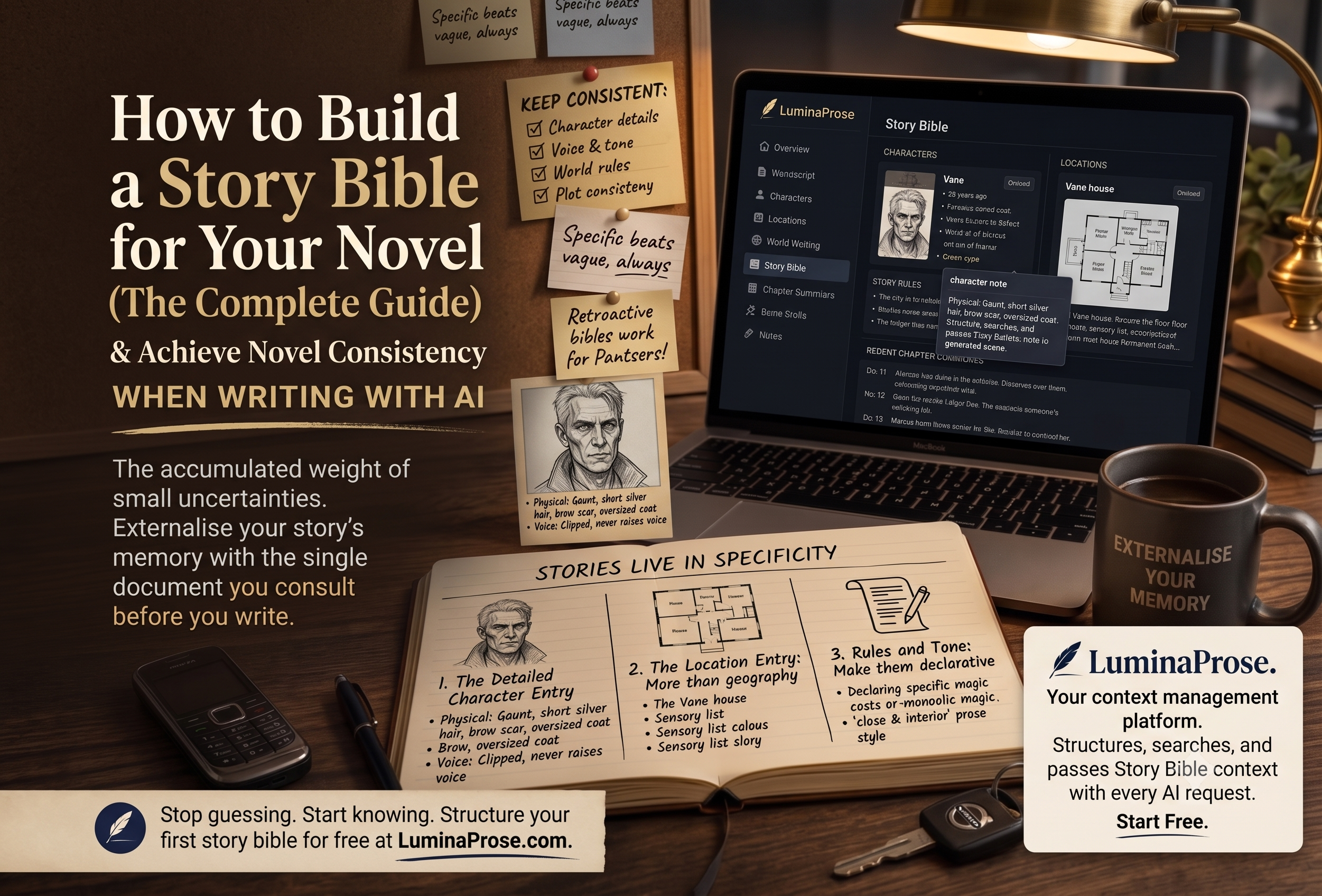
Here is what a complete character entry looks like:
Marcus Vane
Role: Protagonist. Homicide detective, 22 years on the job.
Physical: 52 years old, gaunt — not thin, gaunt, the kind of face that makes strangers look twice and then away. Silver hair kept short. A scar through his left eyebrow from a bar fight in 1997 he has never explained. Almost always wearing a coat one size too large, as though he is still the thinner man he used to be.
Voice and manner: Clipped. Never raises his voice when angry — goes quieter instead, which people find more unsettling. Asks questions he already knows the answers to. Never thanks people directly; says "that's useful" as the closest he gets. Left-handed. Writes in capital letters.
Core motivation: Wants to close cases. Needs, at a deeper level, to believe that order is possible in a disordered world — a belief his caseload keeps steadily undermining.
Secrets: His daughter has not spoken to him in three years. He knows exactly why.
Key relationships: His partner, Elena Morse — he respects her and quietly resents how quickly she has become better than him at the parts of the job that matter.
Continuity notes: Allergic to shellfish. Drives a 2009 Volvo he refuses to replace. Does not own a smartphone; still uses a flip phone. Mentioned in Chapter 3 that he grew up in Salford.
Notice what this does. It gives you physical specificity you can reach for in any scene. It tells you how he speaks, so you do not have to reinvent his voice each time. It captures his contradiction — the belief in order, the evidence against it — which is where his drama lives. And the continuity notes section at the bottom is where you log the small facts that emerged organically as you wrote him, so you do not forget them.
Build an entry like this for every major character before you write their first scene, and update it whenever a scene reveals something new about them. For minor characters, a shorter version works — role, physical note, one-line voice description — but the principle is the same: specific beats vague, always.
Building Your Location Entries
Locations are the second pillar. They are often underdeveloped in writers' notes — a name and a vague sense of atmosphere — and then rendered inconsistently across the manuscript.
A useful location entry covers:
Name and type. The Vane house. Residential, semi-detached, North Manchester.
Physical layout. What the reader needs to orient themselves: the front door opens directly into the living room, no hallway. The kitchen is at the back, looking onto a garden that has not been tended since his wife left. The staircase is narrow.
Atmosphere and sensory details. What it feels like to be there. The specific texture that makes it different from every other house in your story. Cold even in summer. Smells faintly of old newspaper. The boiler clicks.
Narrative function. What this place does in your story. The house is where Marcus is most exposed — he has no professional armour here. Scenes set here should make him smaller, not larger.
Continuity notes. The neighbour on the left is called Mrs Achebe. She brings him food he does not eat. He has never told her to stop.
The narrative function note is the one most writers omit and most need. A location in fiction is not just geography. It shapes behaviour. When you know what a place does, you make better choices about which scenes to set there.
World Rules, Tone, and the Rest
Beyond characters and locations, your bible should capture any facts about your world that are easy to lose and expensive to contradict.
World rules. Essential for speculative fiction: the limits and costs of your magic system, what technology exists and what does not, the political structure your characters navigate. Write these down as declarative statements — not "magic is hard" but "using the Craft costs the user one sense permanently, in the order: smell, taste, hearing, sight, touch." Specific, testable, consistent.
Tone and style notes. A brief description of the register you are aiming for. Dark but not nihilistic — the world is broken but characters still make meaningful choices. Prose close and interior. Violence sudden, not dwelt on. This sounds vague, but having it written down prevents the drift that happens across a long manuscript: the first act written when you were excited, the third act written when you were tired, the two halves sounding like different books.
Timeline. A simple chronology of your story's events. Particularly important in mysteries, thrillers, and any plot with multiple timelines. When did the murder happen? How many days have passed since Chapter 1? This does not need to be elaborate — a list of dates and key events is enough. But without it, you will contradict yourself.
When to Build It: The Pantser Question
Planning writers will build the bible before they write. That is the straightforward case.
Discovery writers — those who find the story by writing it rather than outlining it — often resist pre-planning on principle. They worry that defining a character too precisely before writing them will kill the spontaneity that makes discovery writing work.
This is a false dilemma. The bible does not have to come before the writing. You can build it retroactively.
Write your first act the way you normally would. Then, before you begin the second act, go back through what you have written and extract the facts into bible entries. Who are these people now that you have written them? Where have they been? What do you now know about them that you did not at the start?
The retroactive bible serves discovery writers well because it captures the character as they emerged rather than forcing them into a pre-planned shape. The constraint it provides is not about limiting who the character can be — it is about ensuring who they have already become stays consistent from this point forward.
Either approach works. The mistake is having no bible at all.
Keeping It Alive
A story bible is only useful if it is accurate. An outdated bible is worse than no bible — it gives you false confidence.
The discipline that makes the bible work is simple: update it at the end of every writing session, before you close your document.
If a scene revealed something new about a character — a habit, a memory, a relationship detail that emerged organically from the writing — add it to their entry. If you changed a location's layout mid-scene, update the location entry. If you established a new rule of your world, write it down.
Five minutes. No more. The payback is enormous.
The other maintenance habit: when you spot a contradiction in your manuscript, do not just fix the scene. Fix the bible entry that allowed the contradiction to happen. The scene is a symptom; the bible entry is the source of truth.
The Story Bible and AI
If you use AI tools in your writing process, a well-built story bible transforms the quality of what you get back.
The core problem with AI-assisted fiction — as we explored in our previous post — is that AI models can only work with the information in front of them. Without your character and world context, they fill gaps with generic choices. Your stoic detective becomes chatty. Your magic system loses its costs. The AI writes a competent scene for a story it does not know.
A complete story bible solves this. When your character descriptions, location details, and world rules are in front of the model for every generation, the output becomes dramatically more accurate to your specific story. Not because the AI has memory — it does not — but because you have given it the facts it needs to stop guessing.
The manual version of this is copy-pasting relevant bible entries into each prompt before you generate. It works, and it is worthwhile even if it is slightly laborious.
The automated version is a tool that manages this for you — passing your Story Bible context with every AI request so you do not have to think about it. That is the core of what we built with LuminaProse. Your character entries, location entries, and story rules are structured, searchable, and attached to every generation automatically. You write the story; the context management happens in the background.
Whichever approach you use, the principle is the same. The story bible is not optional infrastructure. It is the foundation that makes everything built on top of it — AI-assisted or otherwise — actually work.
A Starting Template
If you want to begin today, here are the fields that matter most for a character entry:
- Name and aliases
- Role (protagonist, antagonist, supporting — and their function in the plot)
- Physical description (specific details, not general impressions)
- Voice and speech patterns (how they talk, what they avoid saying)
- Core motivation (what they want, and what they actually need)
- Secrets (what they are hiding, and from whom)
- Key relationships (and the tension in each)
- Continuity notes (facts that emerged in the writing — keep adding to this)
For locations:
- Name and type
- Physical layout (what someone walking in would see)
- Atmosphere (sensory, specific)
- Narrative function (what this place does to your characters)
- Continuity notes
Start with your three most important characters and your two most important locations. That is a working bible. Expand it as your manuscript grows.
If you would rather not build and maintain this in a separate document, LuminaProse structures your Story Bible directly inside your writing workspace — characters, locations, and notes are organised and passed to every AI generation automatically. Start free, no credit card required.
By LuminaProse Team · June 2026